Yoto Player Review (3rd Gen): Honest Verdict, Card Costs + Yoto vs Toniebox (2026)
Most parents want less screen time for their kids. But handing a young child a phone or tablet creates its own problems. The Yoto Player takes a different path. It plays stories, music, and podcasts from physical cards, with no screen at all. So is it worth $99.99 to $119.99?
In this honest review, I cover the 3rd Generation player in detail. I go through the card costs, the sleep features, and the Wi-Fi catch. I also compare it with the Toniebox, its biggest rival. Finally, I explain why the new 4th Generation makes this older model a smart value pick right now.
The short version: The Yoto Player (3rd Generation) is a screen-free audio player that kids run by themselves with physical cards. It doubles as a night light, an OK-to-wake clock, and a room thermometer. The library holds more than 1,000 cards, and the content grows with your child up to age 12. However, the cards cost extra, and the player needs Wi-Fi for setup. Even so, at $99.99 to $119.99 it undercuts the new 4th Generation by about $30 to $50.
Best for: Parents of kids aged 3 to 12 who want screen-free stories and music that one device can handle for years.
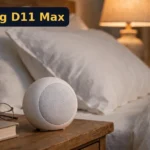
The Yoto Player (3rd Generation) is a screen-free audio player for children aged 3 to 12. Kids insert a physical Yoto Card to play stories, music, or podcasts. It also works as a night light, an OK-to-wake clock, and a room thermometer, with free parent controls in the Yoto app.
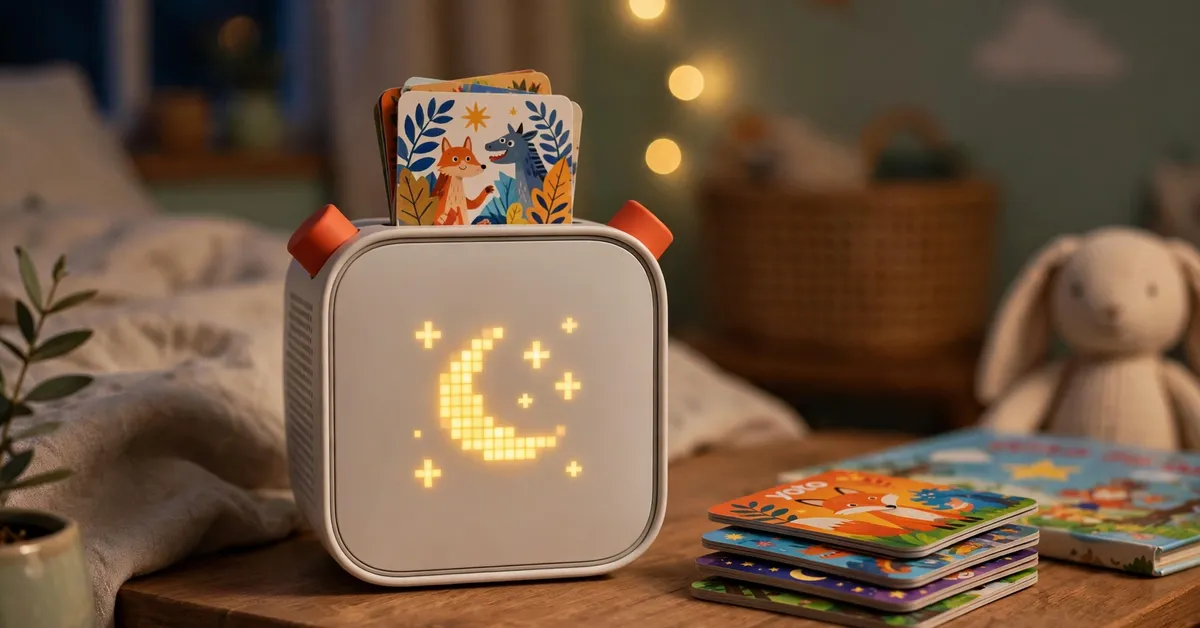
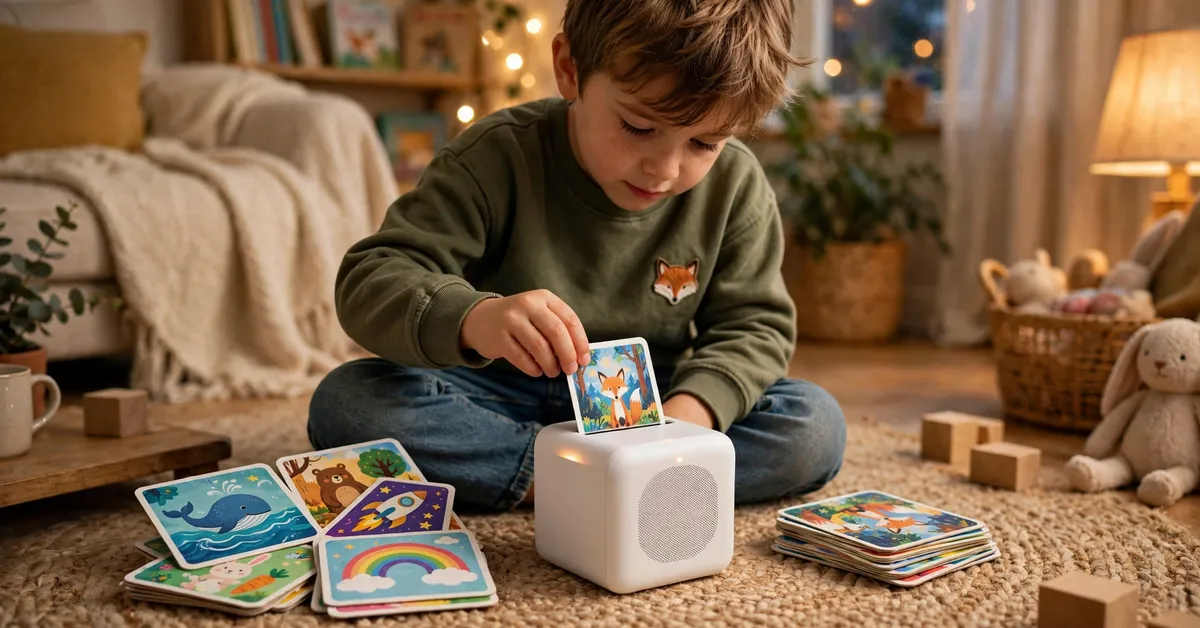
The idea is simple. There is no touchscreen, no camera, and no ads. Instead, your child picks a card, slots it into the top, and the audio starts. Two chunky orange dials control the volume and skip tracks. As a result, even a three-year-old can run it alone. That independence is the real product here.
Who is it for? It suits families who want stories and songs without a glowing screen. It also suits parents who need a bedtime routine helper. However, it does not suit anyone who expects free unlimited content. The player is the hardware. Above all, the card library is where the ongoing money goes, and I break that down in full below.
Who Makes It? Brand Credibility Check
Yoto is a London-based company that has sold screen-free audio players since 2017. The 3rd Generation player launched in 2023, and the company rolled out a 4th Generation in October 2026. A brand that keeps building new hardware is a healthy sign. It is not a one-off gadget from an unknown seller.
The listing also holds an Amazon rating of about 4.6 stars. That is a strong score for a kids’ tech product. In addition, the card library now passes 1,000 titles, with stories from major publishers next to Yoto’s own originals. Parent blogs and review sites cover the player heavily, so there is plenty of independent coverage to check.
Still, one point belongs here. Yoto earns money from an ecosystem, not one box. Cards, accessories, and the optional Yoto Club all sit behind the first purchase. That model is normal in this category, and the Toniebox works the same way. But it means your real cost is the player plus a growing card shelf. I rate the brand credible, and the business model is the thing to budget for.
Yoto Player Features — In Detail
Physical Cards Kids Control Themselves
Each Yoto Card holds one album, story collection, or activity pack. Your child slots a card in, and playback starts at once. Pull the card out, and the audio stops. There are no menus to get lost in. For example, the same title on a card can run 30 minutes or stretch past 4 hours for a full chapter book. Because the cards are physical, kids build a shelf they can see, pick from, and trade.
A Library of 1,000+ Cards
The catalog covers music, classic stories, learning packs, and podcasts. Content starts with toddler songs and reaches full novels for older kids. That range matters. A player bought at age three can still serve at age ten, because the cards grow up while the box stays the same. In contrast, many rival systems run out of older-kid content fast. Yoto also adds new titles on a regular basis, so the shelf never goes stale.
Pixel Display and Simple Controls
The front shows a small 16 by 16 pixel display. It is not a video screen. Instead, it shows simple icons, a clock face, and a picture linked to each card. Meanwhile, the two dials keep control physical. One dial sets the volume, and the other moves through tracks. Parents can also cap the maximum volume in the app, which protects young ears.
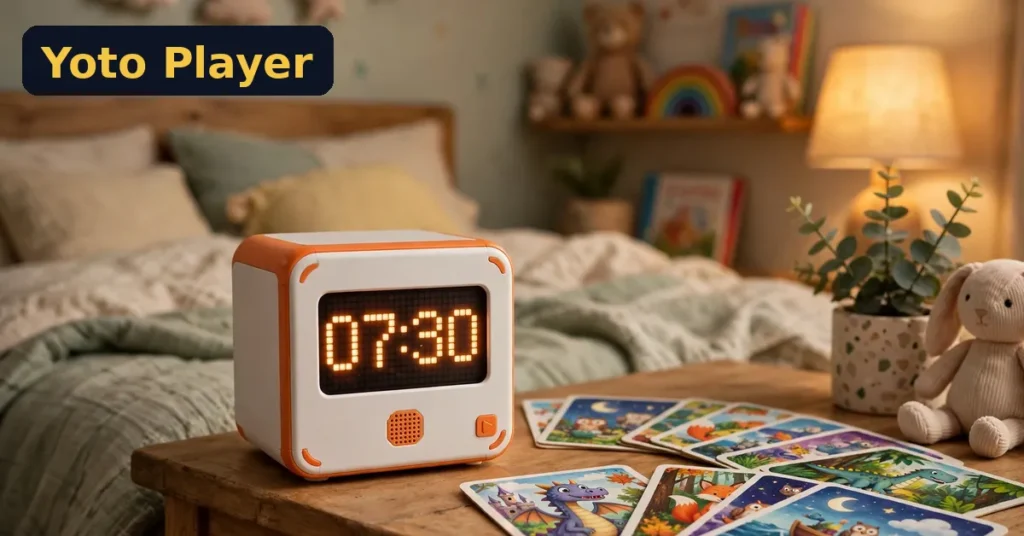
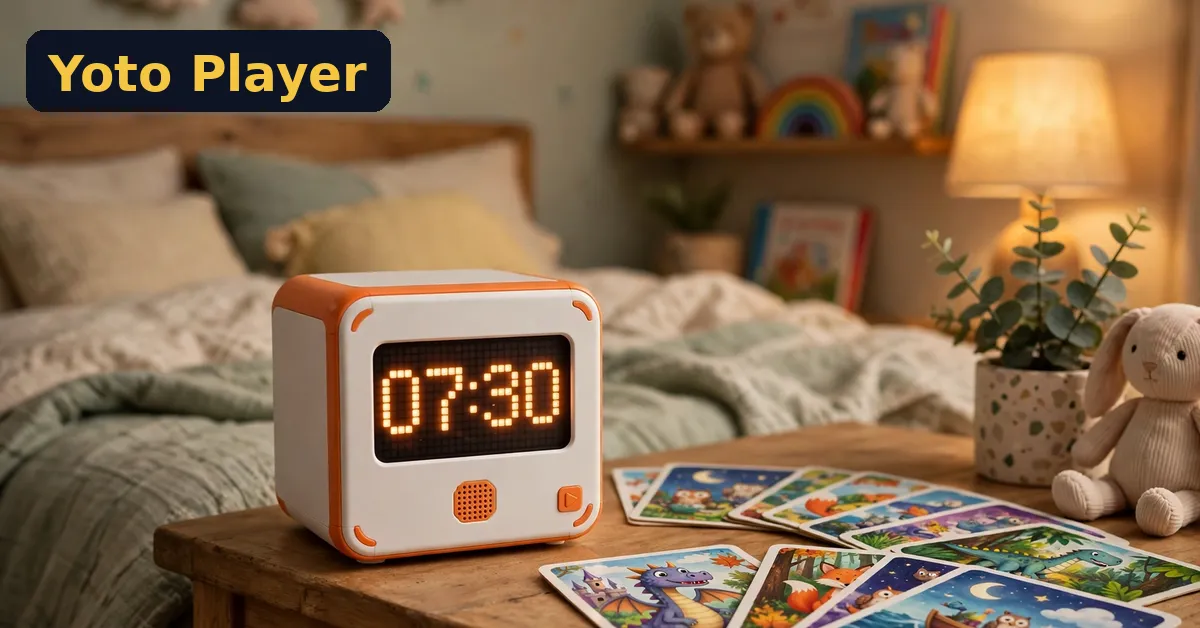
Night Light, OK-to-Wake Clock, and Thermometer
This is where the Yoto earns its bedside spot. The player glows as a night light in seven colors, with adjustable brightness. The OK-to-wake feature then changes the light and display when morning comes. As a result, kids learn when it is time to get up, and parents may win back some sleep. A built-in room thermometer also reports the nursery temperature in the app. Finally, sleep sounds and a power-off timer help the room wind down at night.
Battery and Storage
Yoto claims up to 24 hours of playback per charge. Some reviewers measure closer to 16 hours in heavy use, so plan on the lower figure for long trips. Even so, either number beats most rivals by a wide margin. The player holds 32GB of storage, which fits more than 600 hours of audio offline. It charges over USB-C, and it also supports wireless charging, although the dock sells separately.
The Free Yoto App and Parent Controls
Parents set up the player in the free Yoto app. From the app, you control volume limits, sleep routines, and day and night modes. The app also unlocks free content. That includes the Yoto Daily podcast, the ad-free Yoto Radio station, and sleep sounds. In addition, downloaded cards play in the app too, which helps on car rides. The app is genuinely useful, not a paid add-on.
Make Your Own Cards
Make Your Own cards are blank cards you fill yourself. Each one holds up to 5 hours of audio, across up to 100 tracks. For instance, grandparents can record bedtime stories from far away. You can also load your own music or audiobooks you already own. A Make Your Own card comes in the box as the welcome card, so you can test the idea on day one. This feature stretches the value of the player far past the paid catalog.
Headphones and Bluetooth Speaker Mode
A standard 3.5mm jack and Bluetooth both support headphones. That makes the player workable on planes and in quiet rooms. The 40mm 5W stereo speakers are strong for the size, and they fill a bedroom with ease. The player can also act as a plain Bluetooth speaker for your phone. It is a small bonus, but parents end up using it more than they expect.
Pricing and Full Cost
The 3rd Generation player sells for $99.99 on its own. Bundles with starter cards run up to about $119.99, and Amazon prices move often. Check the current price before you decide. For context, the new 4th Generation player costs $149.99. So the 3rd Gen now sits $30 to $50 below the latest hardware, with most features intact.
Now the honest part. The player is not the whole cost. Each Yoto Card costs extra, and most cards run from $7.99 to $14.99. A first library of 8 to 10 cards adds roughly $80 to $130 in the first months. That said, cards cost less than Toniebox figures, and there is no required subscription at all. The optional Yoto Club runs from $4.99 to $16.99 per month and gives monthly card credits plus discounts. It is a savings tool, never a lock-in.
Full-Cost Summary
Player price: $99.99 standalone; bundles with starter cards up to about $119.99.
Content cards: most Yoto Cards cost $7.99 to $14.99 each — this is the main ongoing cost.
Example first library: 10 cards at about $10 on average adds roughly $100.
Optional Yoto Club: $4.99 to $16.99 per month for card credits and 10% discounts — never required.
Optional Adventure Jacket protective cover: about $29.99.
Optional wireless charging dock: sold separately; USB-C charging works out of the box.
Shipping: standard Amazon delivery terms at checkout.
Returns: covered by Amazon’s standard return policy for this listing.
Fully screen-free listening — kids control stories and music with physical cards.
Huge library of 1,000+ cards that grows with your child, from toddler songs to chapter books.
Cards cost less than Toniebox figures — most run $7.99 to $14.99.
Built-in night light, OK-to-wake clock, and room thermometer in one bedside device.
Long battery life — up to 24 hours claimed, with 32GB storage for 600+ hours offline.
Free extras in the app: Yoto Daily podcast, Yoto Radio, and sleep sounds.
Make Your Own cards hold up to 5 hours of your own recordings.
The Cons
Content cards cost extra — the player alone is just the start of the spend.
Needs Wi-Fi for setup and for downloading each new card the first time.
Flat cards are easier to lose than chunky Toniebox figures.
Hard plastic body is less drop-proof for toddlers than the soft Toniebox.
A 4th Generation model launched in October 2026 at $149.99, so this is now the older hardware.
No replaceable battery — when the battery fades, the whole unit is affected.
Who Should Buy the Yoto Player?
Best For
Parents who want story time and music with zero screen exposure.
Families with kids aged 3 to 12, or siblings who will share one player.
Parents who want a night light, OK-to-wake clock, and audio player in one device.
Gift buyers — cards make easy, low-cost birthday and holiday add-ons later.
Not For
Toddlers under 3 who throw and chew everything — the soft Toniebox survives that stage better.
Anyone who wants unlimited streaming content for one flat fee.
Homes with no Wi-Fi at all — setup and new cards need a connection first.
Buyers who always want the newest model — the 4th Generation is already here.
Yoto Player vs Toniebox — Which One Should You Buy?
This is the comparison most parents actually shop on. Both systems play screen-free audio from physical objects. Both cost $99.99 for the player. However, the details pull in different directions, and the right pick depends on your child’s age.
Design and Durability
The Toniebox is a soft, padded cube. Kids squeeze its ears to change the volume and tap its sides to skip tracks. It shrugs off drops and throws, which suits one and two-year-olds. The Yoto Player is a hard plastic box instead. It feels sturdy, but it is not built for the toddler throwing stage. In short, Toniebox wins on rough handling. Yoto wins once your child is past that phase.
Content and Running Costs
Here the math favors Yoto. Most Yoto Cards cost $7.99 to $14.99, while Tonies figures usually cost $15 to $20 each. The same story can show the gap clearly. One well-known title costs $9.99 as a Yoto Card and $19.99 as a Tonie. In addition, Yoto cards often hold far more audio. A single card can carry a 4.5-hour chapter book, while a Tonie runs 30 to 90 minutes. Over a year of birthdays and holidays, the card shelf grows cheaper and deeper.
Age Range and Features
Toniebox content leans young, with most figures aimed at ages 1 to 5. Yoto covers ages 3 to 12, with chapter books and learning packs for older kids. The Yoto also adds a night light, an OK-to-wake clock, and a room thermometer. The Toniebox offers none of those. Battery life splits the pair as well. The Toniebox runs about 7 hours per charge, while the Yoto claims up to 24 hours, with reviewers seeing around 16. For recordings, a Creative Tonie holds 90 minutes. A Make Your Own Yoto Card holds up to 5 hours.
The Vs Verdict
Pick the Toniebox for a child under 3 who needs a soft, simple, throw-proof player. Pick the Yoto Player for a child aged 3 or older. It costs less to feed, lasts for more years, and does more jobs at the bedside. Between the two, the Yoto is the better long-term buy for most families. That is also why this review focuses on it.
My Exclusive Yoto Bonus
When you pick up the Yoto Player through my link, I am adding one original bonus. I built it to solve the exact problem new owners hit in week one — which cards to buy first, and how much to spend:
Bonus: Yoto Starter Card Planner (PDF) — a printable planner that maps the best first cards by age, from toddlers to pre-teens. It also includes a card budget worksheet, so you can plan a starter library without overspending.
Click the download button above to get it instantly — no forms, no waiting.
Frequently Asked Questions
Is the Yoto Player a scam or legit?
It is legit. Yoto is an established company that has sold these players since 2017, and the 3rd Generation holds about 4.6 stars on Amazon. The product does what it promises: screen-free audio from physical cards. The honest caveat is cost, not fraud. The player is only the start, because every content card costs extra.
Does the Yoto Player need Wi-Fi?
Yes, at first. Setup runs over Wi-Fi, and each new card downloads its audio on first use. After that download, the card plays fully offline. Downloaded stories also live on the player’s 32GB storage. So travel is fine. You just need a connection at home when a new card arrives.
How much do Yoto Cards cost?
Most cards cost between $7.99 and $14.99. Card packs and the optional Yoto Club credits can lower the cost per card. For comparison, Tonies figures usually cost $15 to $20 each. My free planner above maps out a starter library by age, with a budget worksheet to keep the total under control.
What age is the Yoto Player for?
Yoto rates it for ages 3 to 12. Younger toddlers can listen with a parent, but the hard body and card slot suit careful hands better. The wide content range is the point. Toddler songs sit at one end, and full chapter books sit at the other, so one player can serve for years.
Do I need a Yoto Club subscription?
No. The player and cards work fully without any subscription. Yoto Club is optional. Its tiers run from $4.99 to $16.99 per month and add monthly card credits, a 10% store discount, and extra digital content. It can save money for heavy buyers, but nothing locks you in.
Should I buy the 3rd Gen or the 4th Gen?
The 4th Generation costs $149.99 and adds a faster processor, 64GB of storage, Wi-Fi 6, and a Green Button for card-free favorites. However, the 3rd Gen keeps the same card library, night light, and OK-to-wake clock for $99.99 to $119.99. If budget matters, the 3rd Gen is the value pick while stock lasts. If you want the longest support life, pay up for the 4th.
Final Verdict: Is the Yoto Player Worth It?
Rating: 4.3/5. The Yoto Player (3rd Generation) delivers real screen-free independence for kids, plus a night light, OK-to-wake clock, and thermometer in one box. The 1,000+ card library grows from toddler songs to chapter books, and the cards undercut Toniebox figures on price. It loses points because content costs extra, setup needs Wi-Fi, and the 4th Generation now exists. Even so, at $99.99 to $119.99 it is the value pick of the Yoto range.
Buy it if: your child is 3 or older, you want years of use from one player, and cheaper content matters to you.
Skip it if: your child is under 3 and rough with toys, you have no Wi-Fi at home, or you only buy the newest model.
I have read the spec sheets, the parent reviews, and the head-to-head comparisons for this player, and one pattern stands out. Families keep the Yoto for years, while many rival players get outgrown in one. The card system is the reason. It starts with songs for a three-year-old and ends with chapter books for a ten-year-old, and the same box handles both. The honest costs are real: cards add up, and setup needs Wi-Fi. But the night light and OK-to-wake clock solve a daily problem, not just playtime. I rate it 4.3 out of 5, and for a child aged 3 or older, I would pick it over the Toniebox and over the pricier 4th Gen.
Affiliate Disclosure
ZoxDeal is reader-supported. When you buy through links on this page, we may earn an affiliate commission at no extra cost to you. As an Amazon Associate, ZoxDeal earns from qualifying purchases. This does not influence our ratings or reviews. We only recommend products we have researched thoroughly, and we always disclose the honest catches we find.